
THE ARETĒ FRAMEWORK
A Structural Model of Leadership, Communication, and Culture
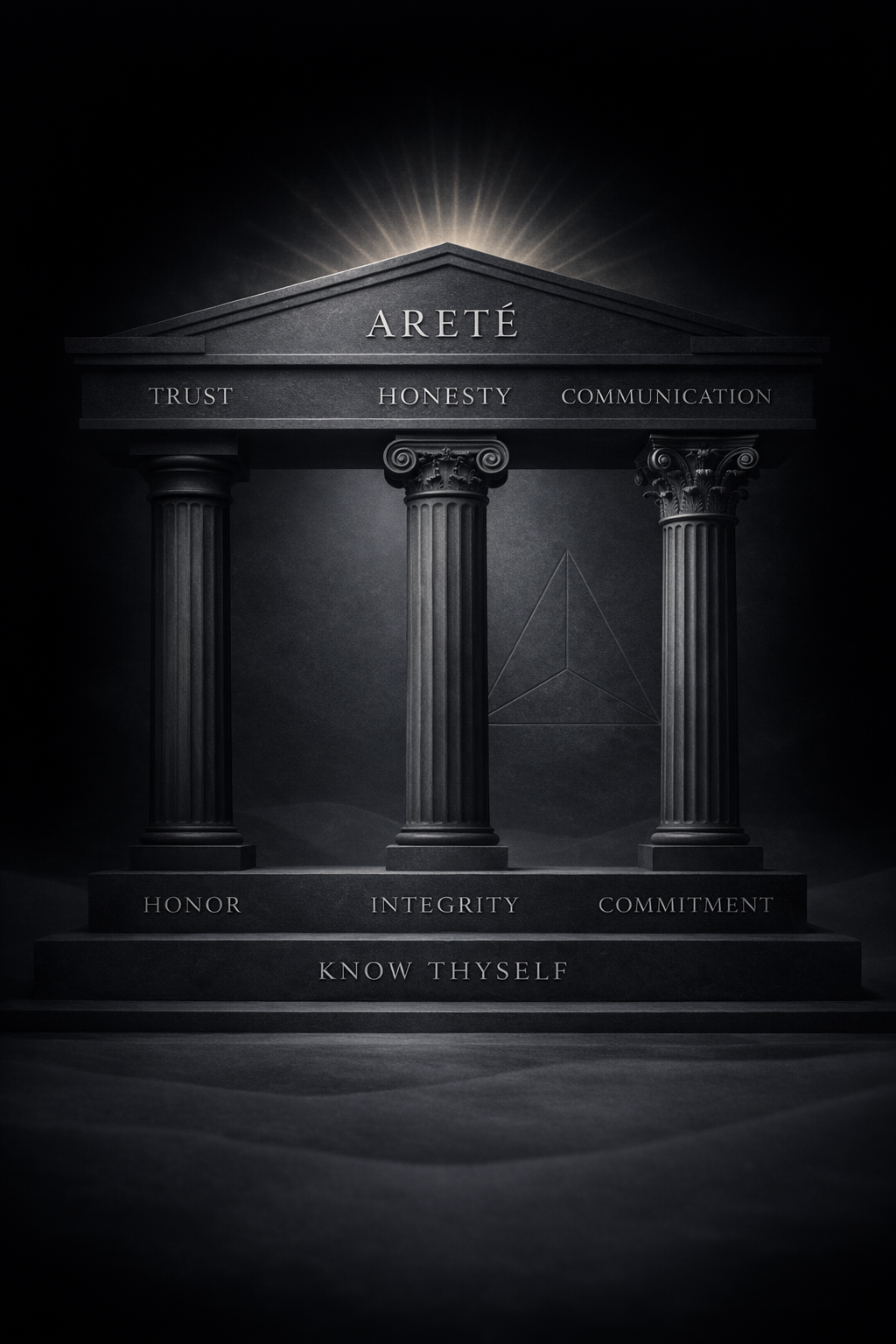
Aretē represents human excellence through alignment—between self, values, and action. The architectural form is intentional: each element reflects a function in how trust is built, meaning is shared, and culture is sustained.
THE PEDIMENT & PILLARS
The pillars represent the interactional values in how humans relate to one another.
-
Aretē crowns the structure as the integrated expression of excellence.
It is not perfection — but alignment
Aretē itself is the synthesis of the whole structure.
It is not about perfection, and it is not image. It is the lived expression of excellence through discipline.
-
THE DORIC PILLAR
- Stability and Reliability
Trust is the load-bearing force of all human systems. Trust is Doric — unadorned, grounded, and strong. It does not seek attention; it earns confidence through consistency.
Like the Doric column, trust is not decorative — but without it, collapse is inevitable.
-
THE IONIC PILLAR
- Clarity and Truth in Expression
Honesty introduces precision and definition into the structure. As the Ionic pillar balances strength with refinement, honesty balances truth with tact.
The Ionic pillar reminds us: truth gives structure its form.
-
THE CORINTHIAN PILLAR
- Connection and Meaning
Communication is the most expressive pillar — complex, relational, and visible. Like the Corinthian order, it carries nuance without sacrificing structure.
The Corinthian pillar reminds us that connection, when structured well, elevates the entire system.
THE FOUNDATION
These ethical values bind the pillars into a coherent system.
-
Honor defines the moral boundary of the structure. It governs how power is used and how people are treated. Honor ensures values are upheld even when inconvenient.
In culture, honor builds reputation and loyalty. It stabilizes trust during pressure and signals long-term thinking.
-
Integrity ensures alignment across all parts. It is the consistency between values, communication, and action. Integrity prevents hypocrisy and sustains credibility.
Organizations with integrity do not fracture under scrutiny — they hold together.
-
Commitment is structural endurance. It sustains effort over time. Commitment turns intention into results and values into habits.
Without commitment, values decay into slogans.
-
Self-awareness is the base of all excellence.
Leaders who understand their biases, triggers, and values communicate more clearly, build deeper trust, and act with integrity.
Without self-knowledge, the structure rests on unstable ground.